The Ultimate Guide to Window Treatments
What needs or purposes will your window treatment be fulfilling? Consider this your ultimate guide to window treatments.
Updated October 5, 2026
The Ultimate Guide to Window Treatments
Every window in your home is an opportunity. An opportunity to control how light enters a room, how the space feels at different hours, how private or open the interior remains, and how the architecture reads from both inside and outside. The window treatment you choose determines all of this. It is not an afterthought. It is one of the most impactful design decisions in any home.
For Denver homeowners navigating new construction, renovation, or simply upgrading from builder-grade coverings, the window treatment market can feel overwhelming. The product categories are broad. The terminology is inconsistent. The difference between a good investment and a disappointing purchase often comes down to understanding what each product actually does and where it performs best.
This guide covers every major window treatment category available to Colorado homeowners. It explains what each product is, how it works, where it belongs, and how to choose between options when multiple products could serve the same window.
The Five Major Window Treatment Categories
Window treatments fall into five primary categories: blinds, shades, drapery, shutters, and specialty treatments. Each category contains subcategories, and within each subcategory, the material, operating system, and mounting method create hundreds of possible configurations. Knowing the categories gives you a framework for every decision that follows.
Blinds consist of horizontal or vertical slats that tilt to control light and stack or draw to one side when fully open. Materials include real wood, faux wood, aluminum, and composite. Blinds offer precise light control because you can adjust the angle of the slats to direct light up, down, or to the side without raising the entire treatment. They are available in standard and wide-slat widths, with cordless and motorized operation.
Blinds are best suited for rooms where adjustable light control is the priority: home offices, kitchens, bathrooms, and bedrooms. Real wood blinds add warmth and texture. Faux wood blinds deliver the same aesthetic with moisture resistance for wet environments. Metal blinds provide a modern, industrial edge.
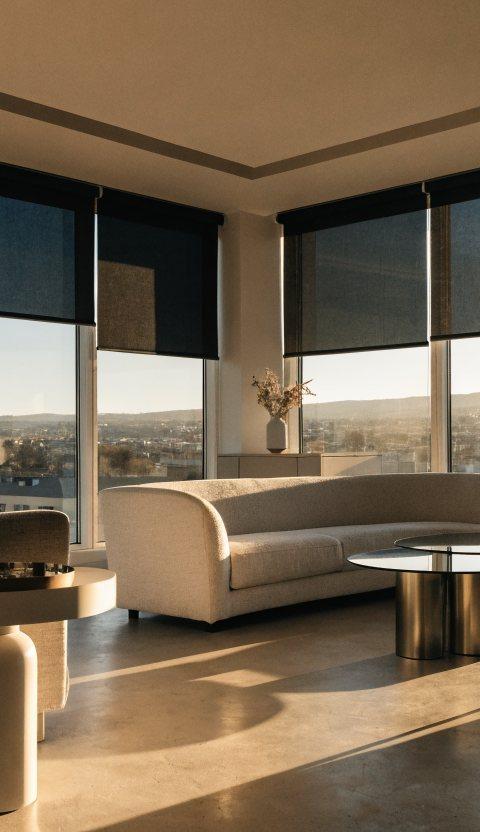
Shades are soft window treatments that use a single panel or structured fabric to cover the window. The category includes roller shades, roman shades, cellular (honeycomb) shades, woven wood shades, solar shades, and pleated shades. Each type offers a different balance of light control, insulation, view preservation, and visual style.
Shades are the most versatile window treatment category. They serve every room, accommodate every design direction from modern to traditional, and span the full performance range from sheer light filtering to total blackout. The variety within the shades category means that a single product type can be customized to fit almost any requirement.
For detailed guidance on specific shade types, explore our guides on Roman Shades, Solar vs. Roller Shades, and Cordless Shades.
Drapery is fabric hung from a rod or track that frames the window and can be drawn open or closed. Custom drapery offers the widest range of design expression of any window treatment. The fabric, the pleat style, the fullness, the lining, and the hardware all combine to create a treatment that is as much a design statement as it is a functional covering.
Drapery excels in living rooms, dining rooms, bedrooms, and any space where the window treatment is meant to be seen and appreciated. Floor-to-ceiling drapery panels add height, warmth, and visual weight to a room in ways that no other treatment can achieve.
For a comprehensive exploration of custom drapery, see our guide: The Complete Guide to Choosing Elegant Custom Drapery with Blinds Couture.
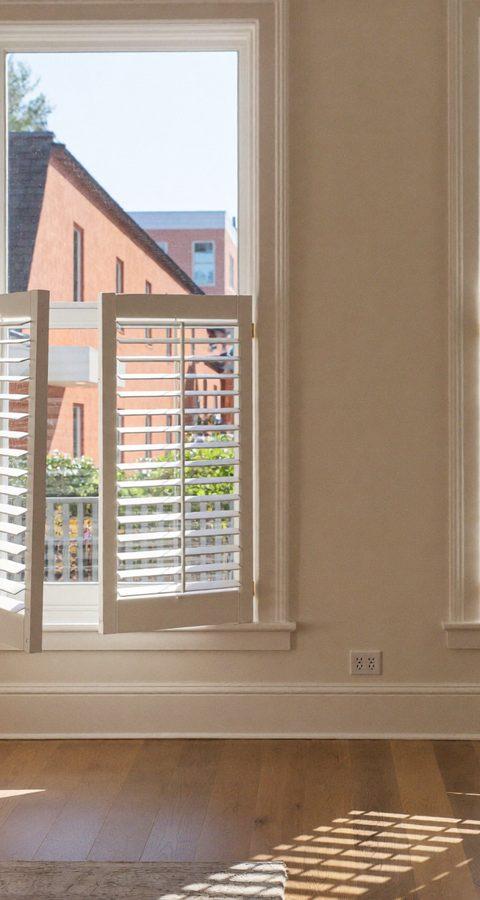
Shutters are rigid panels with adjustable louvers that mount inside or on the window frame. They are architecturally permanent, adding structure and character to the window. Materials include hardwood, composite, and polyresin. Shutters offer excellent light control, insulation, and privacy, and they increase property value because they are considered a permanent improvement rather than a removable accessory.
Shutters work well in transitional and traditional interiors, in homes with deep window frames, and in rooms where the treatment needs to be durable enough to withstand daily use without wear. Plantation shutters with wide louvers are the most popular style in the Denver market.
Specialty treatments include cornices, valances, top treatments, and layered combinations. These are typically decorative elements that complement a primary functional treatment below. A fabric-upholstered cornice above a roller shade, or a valance topping a set of drapery panels, adds a finished, architectural element to the window.
Choosing by Room Function
The most effective way to narrow your options is to start with the room and work backward to the product. Every room has a primary function, and that function drives the performance requirements for the window treatment.
Bedrooms need darkness for sleep. Blackout-lined roman shades, blackout roller shades, or drapery with blackout lining are the foundation. Layering a blackout treatment with a decorative shade or drapery panel creates the combination of function and beauty that makes a bedroom feel like a retreat.
Living rooms and great rooms need versatility. Light changes throughout the day, and the treatment should accommodate both bright daytime function and intimate evening ambiance. Solar shades, light-filtering roller shades, or drapery panels that can be drawn open or closed provide that flexibility.
Kitchens need treatments that stay clear of water, heat, and food preparation zones. Roman shades, roller shades, and woven wood shades mounted inside the window frame keep fabric contained and accessible. Performance fabrics that resist moisture and staining are the practical choice.
Bathrooms need privacy and moisture resistance. Faux wood blinds, roller shades in synthetic fabrics, and top-down/bottom-up cellular shades allow natural light from the top of the window while maintaining privacy below.
Home offices need glare control. Solar shades and light-filtering roller shades reduce screen glare while maintaining ambient light and connection to the outdoors. Motorized operation allows adjustments throughout the workday without leaving the desk.
Dining rooms are design moments. Floor-to-ceiling drapery, layered with a roman shade or roller shade behind, creates the visual richness that a dining room demands. Fabric selection here should lean toward texture and warmth.
Choosing by Design Style
Your home's design direction influences not just the product type but the material, color, and hardware that accompany it.
Modern and contemporary interiors favor clean lines and minimal profiles. Roller shades, solar shades, and ripple fold drapery on track systems deliver the architectural simplicity these styles demand. Colors tend toward neutrals: whites, grays, charcoals, and warm taupes.
Transitional interiors blend traditional warmth with modern restraint. Roman shades, Euro pleat drapery, woven wood shades, and plantation shutters all work beautifully in transitional settings. Fabrics lean toward textured neutrals with occasional accent color.
Traditional interiors embrace pattern, richness, and formal structure. Pinch pleat and goblet pleat drapery, hobbled roman shades, silk, and velvet are the native vocabulary of traditional window treatment design. Hardware is decorative, with visible rods, finials, and rings.
Mountain and rustic interiors call for natural materials and organic textures. Woven wood shades, linen drapery, real wood blinds, and unrefined textures ground the treatment in the landscape. Warm earth tones and natural fiber weaves are the foundation.
The Investment Question: Do Custom Window Treatments Add Value?
Custom window treatments are one of the highest-return soft furnishing investments a homeowner can make. They improve energy efficiency, protect furnishings from UV damage, enhance privacy, and elevate the visual quality of every room. For homes approaching sale, professionally installed window treatments signal to buyers that the home was maintained with care and designed with intention.
For a detailed exploration of how window treatments affect property value, read our article: Do Custom Window Treatments Add Value for Your Home?.
Working with a Professional
The difference between selecting window treatments on your own and working with a design professional is the difference between assembling a wardrobe from individual pieces and having a stylist build a cohesive collection. A Blinds Couture design consultant sees the whole picture: how each window relates to the others, how the treatments interact with the room's design, and how the functional requirements of each space align with the product options available.
The complimentary in-home consultation is the starting point. Your design associate walks through your home, discusses your goals for each room, and presents options that are tailored to your architecture, your lifestyle, and your aesthetic. No pressure. No predetermined solution. Just expert guidance from a team that does this every day.
Book Your Complimentary Design Consultation
Blinds Couture is Denver's premier custom window treatment studio, offering blinds, shades, drapery, shutters, and specialty treatments from Hunter Douglas, Graber, Norman, Alta, Lutron, Conrad, and Hartman and Forbes.
Serving Denver since 1999
Blinds Couture Showroom
590 Quivas St
Denver, CO 80204
(720) 729-0091

Blinds Couture
Denver's premier custom window treatment studio
With over 25 years serving Colorado homeowners and designers, Blinds Couture brings expert knowledge in custom drapery, blinds, shades, shutters, and motorized window treatments. Our team combines design expertise with hands-on craftsmanship to create beautiful, functional spaces.
Learn more about our team