Two-Story Window Treatments in Denver: Motorized Solutions for Tall Windows
Foothill great rooms with 20-foot glass walls need engineering, not off-the-shelf shades. Here is how we spec motorized cellular, solar screens, and drapery for tall Denver windows.
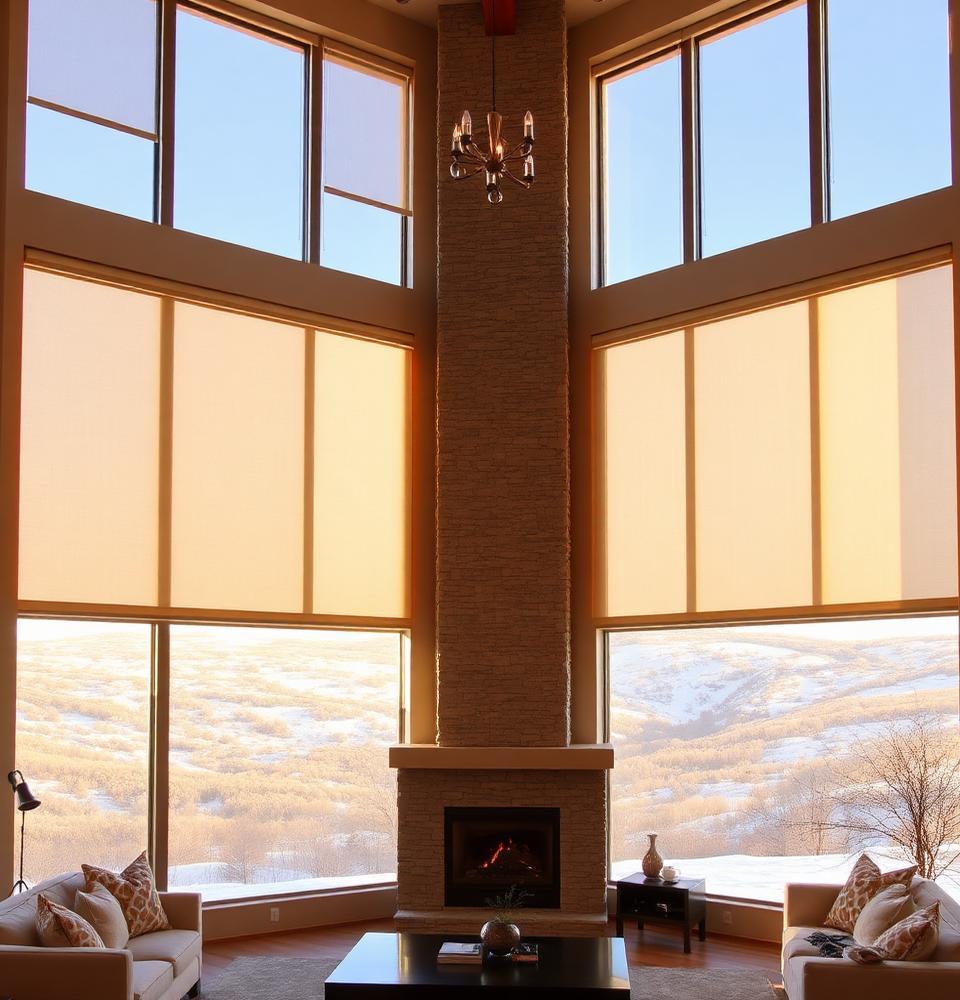
Denver is a two-story great room town. Foothill lots, mountain-view lots, and modern builds in Lone Tree, Castle Pines, and Highlands Ranch are all built around soaring 18-to-22-foot glass walls that pull the outside in. Those windows are the reason clients bought the house. They are also the single hardest window treatment problem we solve.
Tall windows fight physics. Fabric wants to sag. Motors want to hum. Sun angles change through the day and roast the west wall by 4 PM. And nobody wants to see an operating cord dangling 16 feet down the drywall. This guide covers what actually works on tall windows in Denver homes, how we spec motorization for two-story rooms, and what the finished project looks like on a foothill lot in July.
1. Why Standard Window Treatments Fail on Tall Windows
A shade rated for an 8-foot window is not simply a shade rated for a 20-foot window scaled up. The engineering changes. Fabric weight is compounded by drop length, so a fabric that hangs beautifully over a standard bedroom window sags and flutters at 18 feet. Roller tubes deflect under load. Cellular shades cell-crush at the top under their own weight.
The right products for tall Denver windows use heavy-duty tubes, reinforced side rails, and often paired banks of shades rather than one giant span. We usually break a 20-foot window bank into two synchronized shades that move in unison. It looks like one shade. It performs like a much smaller one.
2. The Product Families That Work at Height
Three product families carry almost every two-story install we do.
Motorized cellular shades are the workhorse. The double-cell honeycomb structure adds real R-value to a room that would otherwise be an energy sink in January and a heat trap in July. On a west-facing foothill wall, cellular shades cut summer heat gain by 40 to 60% depending on fabric and cell depth. See our cellular shade collection for cell and opacity options.
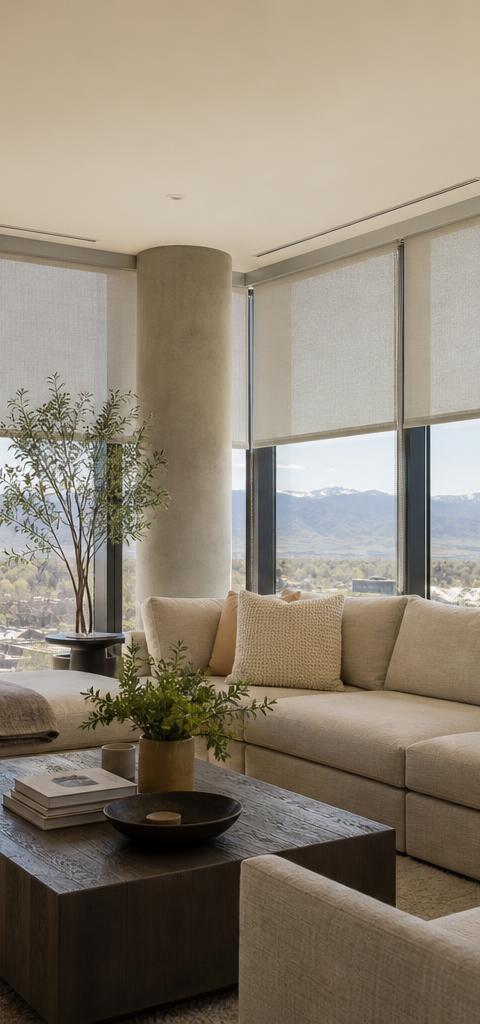
Motorized solar screens handle glare without eliminating the view. This is the product we install most often on the upper transom windows in a two-story great room. Ten-percent openness fabric knocks out UV and reduces glare on the TV or the artwork below while keeping the mountains and the sky visible through the fabric. Our solar shade collection covers the full openness range.
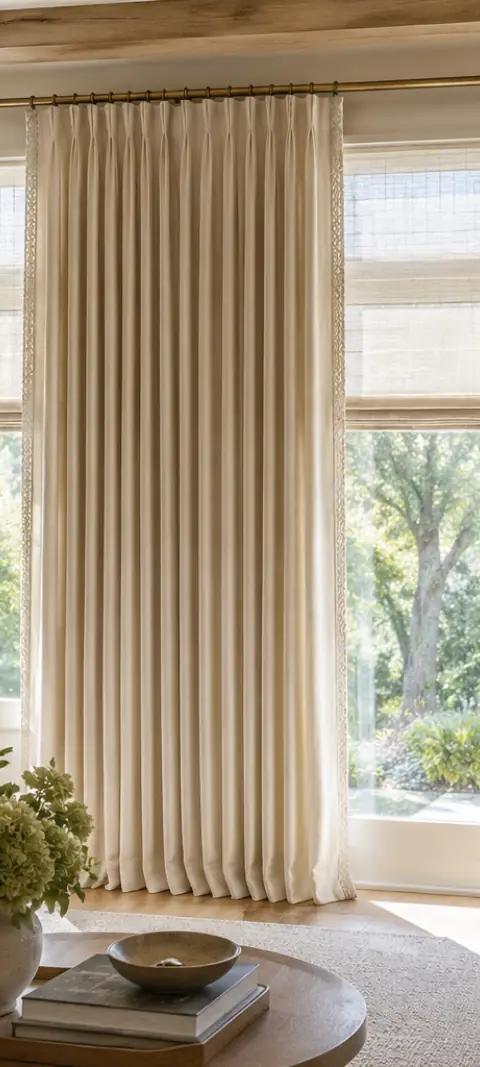
Custom drapery on extended-height rods is the styling layer. We fabricate panels that stack to 20 feet with reinforced headers and weighted hems so they hang straight and move cleanly. See fabric weights and pleat styles in our custom drapery collection.
3. How Do You Reach a Shade That Is 18 Feet Up?
You do not. That is why motorization is not optional on tall windows. It is the entire premise of the install. Hunter Douglas PowerView, Somfy, and Lutron all make battery and hardwired motors rated for the shade sizes we use in two-story rooms. On a fresh drywall install we prefer hardwired for the cleanest look. On a retrofit we use rechargeable battery motors so we do not open walls.
Everything ties into a wall keypad or an app-based scene controller. A morning scene lifts the upper transoms and lower shades to 40%. A movie scene closes the west wall completely. An away scene randomizes shade position through the day so the house does not read as empty from the street. Explore what the current systems can do in our motorized window treatments overview.
4. What About the Sun Angle Problem?
Denver's latitude means the summer sun peaks nearly overhead at noon but stays low and hot in the afternoon. That is why west-facing two-story walls are the hottest surfaces in most local homes from about 3 PM through sunset in July. A single shade drawn top-to-bottom for six hours is not the answer. It wastes the view and cooks the fabric.
The better approach is zoned automation. Upper transoms get a solar screen that stays down through the afternoon to cut UV and glare. Lower windows get a cellular shade that only lowers when interior temperature crosses a threshold or when the client is out. The view stays open when someone is in the room, and the room stays cool when nobody is.
5. Foothill Homes Need a Different Playbook
Homes on foothill lots in Castle Pines and Castle Rock, Lone Tree, and the west side of Highlands Ranch have two-story glass walls oriented toward the mountains. That is west or northwest exposure, and it is the harshest UV load in the metro. Fabric selection matters more here than almost anywhere else.
We spec heavier-weight solar fabric with higher UV block ratings on these lots. Standard 5% openness for view preservation. Heavier 3% openness on the transoms if TV glare is a concern. Cellular shades in ivory or warm gray rather than pure white so the interior color temperature stays warm at sunset.
6. What Does a Tall Window Install Actually Look Like?
A recent Lone Tree great room had a 22-foot glass wall with six upper transoms and four lower fixed windows facing west toward the foothills. We installed:
- Six motorized 3% solar screens on the upper transoms, ganged into one control group
- Four motorized double-cell blackout cellular shades on the lower windows, ganged separately
- Two banks of pinch-pleat drapery on 20-foot iron rods flanking the fireplace wall
- A single wall keypad next to the sectional with morning, day, sunset, and movie scenes
Total install time was 11 hours across two days. The client's summer cooling costs dropped 22% year over year. That is the return on doing tall windows right the first time.
7. How Long Does a Two-Story Project Take?
From consultation to install, typically 6 to 10 weeks. Measurement and design take one visit. Fabric selection and quote take a second visit. Fabrication runs 4 to 7 weeks depending on brand and fabric availability. Installation on a two-story great room typically runs one to two days with a two-person crew and appropriate lifts.
We stage everything before install day so lift time on your floors is measured in hours, not days. Every install ends with the client running their own scenes on the keypad before we leave.
Ready to Solve Your Tall Window Problem?
Tall windows are what our design team was built for. We have installed motorized solutions in great rooms across Cherry Creek, Boulder, Greenwood Village, and every foothill neighborhood in between. If you have a two-story window wall that has never had the right treatment, we would like to see it.
Book a complimentary design consultation and we will walk the room, take exposures, and come back with a scaled plan and real fabric samples.
Serving Denver since 1999
Blinds Couture Showroom
590 Quivas St
Denver, CO 80204
(720) 729-0091
Blinds Couture
Denver's premier custom window treatment studio
With over 25 years serving Colorado homeowners and designers, Blinds Couture brings expert knowledge in custom drapery, blinds, shades, shutters, and motorized window treatments. Our team combines design expertise with hands-on craftsmanship to create beautiful, functional spaces.
Learn more about our team