Sliding Patio Door Window Treatments in Denver: Best Options for Light, Privacy, and Easy Access
Compare vertical sheers, panel tracks, traverse drapery and split shades for a Denver sliding patio door, with practical questions about clearance and privacy.
Updated October 5, 2026
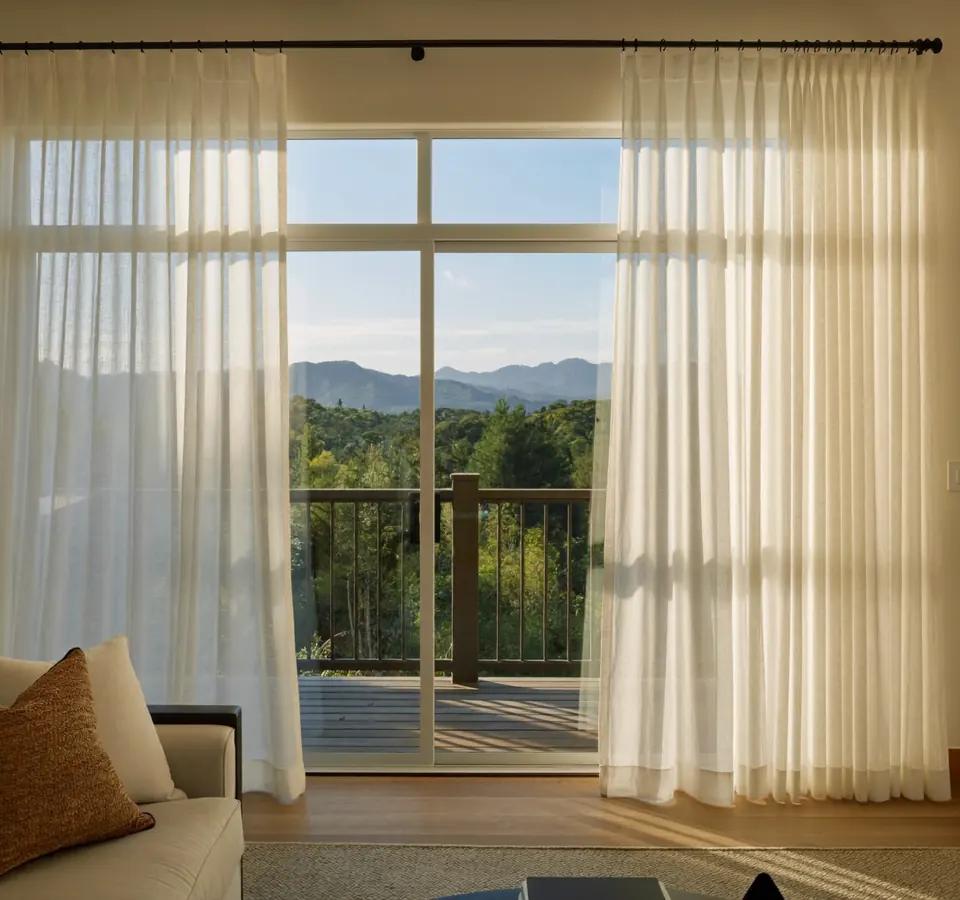
Sliding patio door window treatments in Denver need to manage light and privacy without blocking the path to the deck. Start with the direction the door opens, the space for fabric to stack, and the sun at the hour you use the room. Our window treatment design guide puts this decision in a wider room plan.
Why is a sliding patio door harder to dress than a window?
A patio slider is both a broad glass surface and a doorway people use throughout the day. A treatment must clear the active panel, door handle, and furniture while leaving room to gather when open. On a west-facing Denver wall, afternoon sun adds glare, so fabric selection matters alongside how the treatment moves.
Walk through the door with the current covering fully open. Does the fabric touch the handle or crowd the stationary glass? Where does someone carrying groceries naturally reach? Check whether a screen door or nearby chair changes the available space. A closed treatment may look balanced in a photograph yet interfere with everyday access to the deck.
Which treatments keep access easy while managing light?
Vertical sheer shadings, panel track systems, and traverse drapery can all move horizontally with a sliding door. Vertical blinds also follow the opening and deserve consideration when straightforward operation is the priority. Choose according to clear width beside the frame, desired daylight, and whether nighttime privacy requires a more opaque layer.
Luminette-style vertical sheer shadings combine a soft fabric look with adjustable vanes. They draw aside for passage but need a suitable stacking area. Sheer fabric that feels private during the day may show more of a lit room after dark. Ask to view samples in both open and closed positions against your own glass.
Panel track systems use broad panels on parallel tracks. Their crisp geometry suits wide openings, but the panels overlap when gathered. Measure the wall beside the door and ask where the parked panels will sit. If there is little adjacent wall, consider whether the stack can rest over fixed glass rather than obstruct the active panel.
Drapery on a traverse rod moves along a track without frequent handling of the fabric. A lining changes evening privacy and light control; a sheer layer offers a different effect. Discuss rod projection, fabric fullness and weight, and whether a one-way or center draw fits the doorway. Our living room layering guide explores complementary coverings.
How do the main patio door options compare?
Compare each option with the door open, not just from a photograph of the treatment closed. A covering that clears the traffic path and leaves the handle usable feels different from one that crowds the doorway. Exact stack size, filtering, and privacy depend on the chosen product and material.
| Option | How it opens | Stack and clearance | Light and privacy | Best for |
|---|---|---|---|---|
| Vertical sheer shadings | Vanes rotate; fabric traverses | Needs side stack and track clearance | Filtered light; privacy varies by vane position | Soft look on broad glass |
| Panel track | Panels slide across tracks | Overlapping panels need parking space | Fabric choice sets filtering and screening | Clean lines and wide openings |
| Traverse drapery | Fabric draws along a rod or track | Fullness needs side room | Sheer or lined fabric changes coverage | Layered rooms |
| Vertical blinds | Slats rotate and draw aside | Check vane stack by active panel | Adjustable daylight and visual screening | Direct horizontal access |
| Split roller or solar shades | Separate shades lift vertically | Check headrail and door travel | Fabric affects glare and evening privacy | Separate control of door and fixed glass |
Can roller or solar shades work on a sliding layout?
Roller or solar shades can work if the active door and adjacent fixed glass are treated as separate sections. Raise the active section before going outside, then leave the other at a different height. A split layout needs careful measurement so bottom bars, headrails, and controls do not catch on the door.
This is not the same question as choosing between solar and roller fabrics for a standard window. Solar material may soften daytime glare and retain a filtered view, but it may not provide privacy after dark with lights on indoors. An opaque roller fabric changes that tradeoff. Test the selected material in daylight and evening conditions.
What should be measured before ordering?
Measure the full opening, the wall on both sides, and the depth of the handle and trim. Mounting height above the frame affects how fabric clears the passage and how much glass remains visible when open. A designer should check the header for the proposed track and note nearby vents or switches.
Decide whether the treatment stacks toward the fixed panel or away from the doorway. The fixed panel is not always the right place to park fabric if it holds the view you most want to preserve. Compare ceiling and wall mounting, dining furniture, screen-door movement, and the pathway people take through the room.
At a consultation, open and close the door while considering samples. Ask to see how the product folds or gathers at the actual opening. A measurement of glass alone cannot describe a usable installation. If the door serves a kitchen or breakfast area, consider cleaning and food-preparation traffic too.
When is motorization useful for a patio slider?
Motorization may suit a wide or frequently adjusted treatment, particularly when its control point is difficult to reach. It does not solve an awkward stack or handle collision. Check the movement path first, then ask whether the selected product supports powered operation and how controls, power, and manual access work.
Consider whether every section should move together or whether fixed glass could remain screened while the door stays clear. For an overhead opening in the same room, our motorized skylight shade guide covers different access and power questions. A room can use separate controls for different openings rather than a single compromise.
What questions should you ask during a design visit?
Ask where the treatment sits when open, where it rests when closed, and how much usable opening remains. Compare day and night privacy with real samples. Confirm which panel is active, whether a screen door affects clearance, and who will use the door most often.
- Can the active panel open fully without touching fabric or hardware?
- Where does the stack rest while the door is in use?
- Does the material provide privacy after sunset?
- Is the mounting surface suitable for the chosen track?
- How will guests operate it without pulling on fabric?
- Can the track and door still be cleaned easily?
For a door-specific review, explore our Denver sliding patio door treatments and request an in-home design consultation. We can compare samples at the door, check clearances, and plan an opening that remains comfortable to use.
Frequently asked questions
What is the easiest treatment to open beside a sliding patio door?
A horizontally traversing treatment often follows the door's movement, but the easiest choice depends on its stacking location. Try vertical sheer shadings, panel track, or traverse drapery in the open position at your doorway.
Do vertical sheer shadings give privacy at night?
Privacy depends on vane position, fabric, and interior lighting. Sheer material that screens a room in daylight may reveal more after dark. Check a sample with the room lit before selecting it for a street-facing door.
Can I use separate shades on a sliding door and its fixed panel?
Yes. A split layout may let you raise the active door's shade while leaving fixed glass covered. Headrail placement and bottom-bar clearance must be checked so the shade never obstructs door travel.
Should a patio door treatment stack on the left or right?
Choose the stack side after identifying the active panel, the view to preserve, and available wall. It should clear the traffic path without hiding the room's most useful sightline when open.
Can a patio door treatment be motorized?
Some compatible traversing treatments and shades can be motorized. Confirm the chosen product's operation, control placement, and power requirements. Motorization complements a sound clearance plan; it cannot replace one.
Should I mount the treatment above the patio door frame?
Mounting above the frame can create room for hardware and a clean visual line, but the mounting surface and nearby ceiling features matter. Measure handle, trim, and fabric stack before choosing the exact height.
Serving Denver since 1999
Blinds Couture Showroom
590 Quivas St
Denver, CO 80204
(720) 729-0091
Blinds Couture
Denver's premier custom window treatment studio
With over 25 years serving Colorado homeowners and designers, Blinds Couture brings expert knowledge in custom drapery, blinds, shades, shutters, and motorized window treatments. Our team combines design expertise with hands-on craftsmanship to create beautiful, functional spaces.
Learn more about our team